 Important: Multiple businesses use the “Ratna Kendra” name in Lucknow. Our Official Ratna Kendra® store is located in Chowk Sarrafa Market, Lucknow.

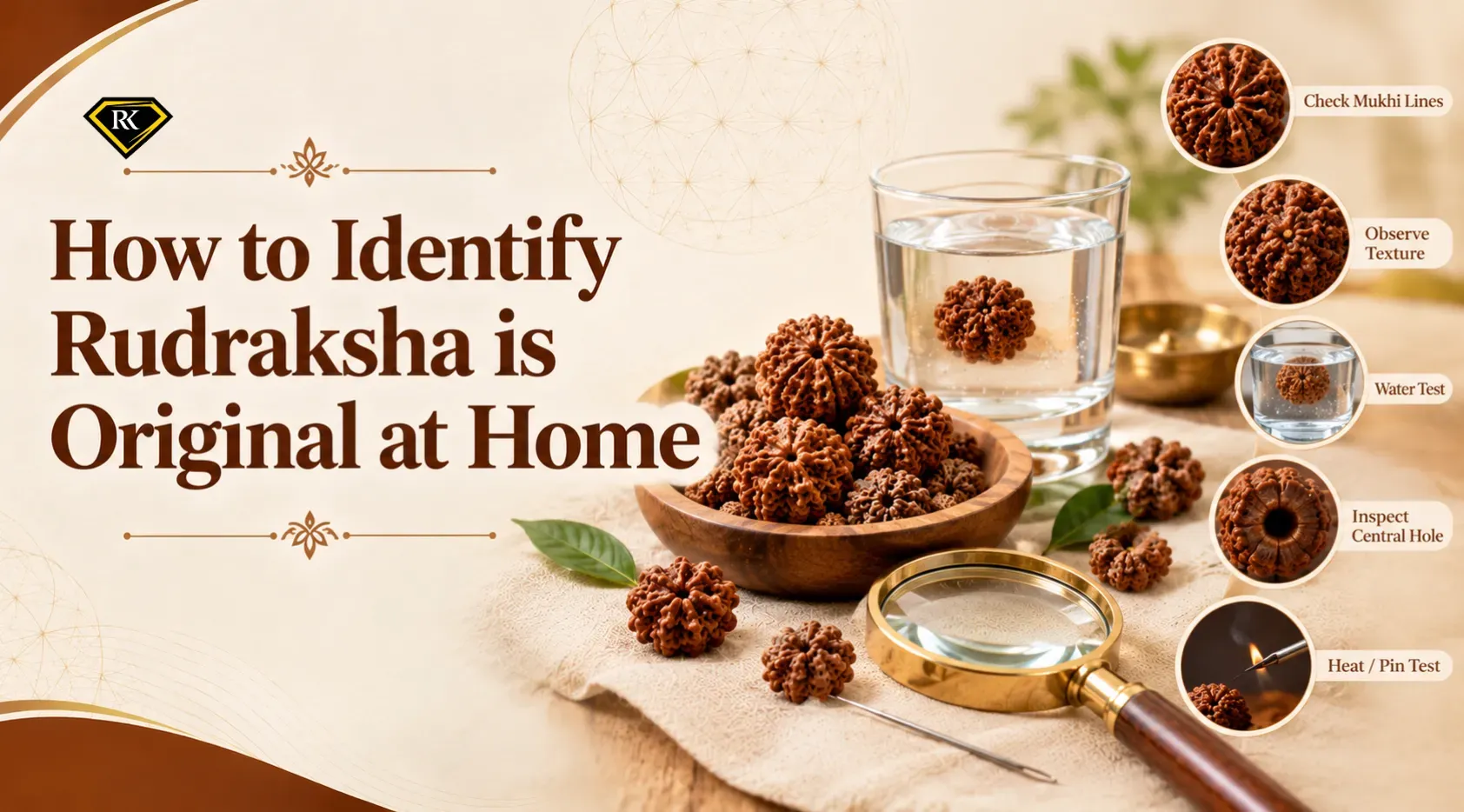
Quick Answer: To check if a Rudraksha is original at home, look at the mukhi lines, rough surface and natural shape. Then try the rudraksha water test and a careful needle test on a spare bead. No home test is 100% proof, so confirm valuable beads with a lab report.
You paid good money for a Rudraksha, and now a small voice asks: is this really real? Many buyers feel this doubt, because fake beads are everywhere, from roadside stalls to online listings.
The good news is you do not need a lab to get started. This guide shows you how to test rudraksha is original at home using simple checks like mukhi lines, texture and the rudraksha water test. These checks will not give you a final verdict, but they will help you catch the obvious fakes early, before you spend more or start wearing it. Let’s get started!
Table of Contents
ToggleWhat Is an Original Rudraksha?
An original Rudraksha is the dried seed of the Elaeocarpus ganitrus tree. Nature shapes every bead differently, so original rudraksha identification starts with knowing these signs:
- A rough, uneven surface with tiny pits
- Natural lines (mukhis) running from top to bottom
- A slightly uneven shape
- No two beads exactly alike
7 Ways to Identify an Original Rudraksha at Home
These seven checks take only a few minutes. Use a good light and a magnifying glass if you have one.
1. Check the Mukhi Lines
Mukhi lines are the natural grooves running from the top of the bead to the bottom. On an original bead they look deep and continuous.
How to check:
- Run a fingernail along each line. It should follow the groove smoothly without breaks.
- Count the lines and match them with the mukhi the seller claims.
- Look under a magnifier. Carved lines look shallow, scratchy or painted. Sellers often carve extra lines on 4 or 5 mukhi beads to sell them as rare ones.
2. Observe the Surface Texture
A real Rudraksha has a rough, bumpy skin with tiny pits and ridges. Very smooth, shiny beads deserve a second look.
How to check:
- Rub your thumb over the bead. You should feel small bumps and uneven patches, not a polished surface.
- Look closely for natural pits between the ridges.
- A light shine from oil is normal, but a glassy coating is not.
3. Look for Natural Shape Variation
Seeds grow on trees, not in factories. So a real bead is rarely a perfect sphere, and no two beads match exactly.
How to check:
- Place a few beads side by side. Small differences in size and shape are a good sign.
- Roll the bead on a flat surface. It may wobble slightly.
- Be careful with a mala where every bead looks identical. It may be moulded.
4. Inspect the Central Hole
The hole tells a lot. On a natural bead it runs straight through from top to bottom and looks slightly rough inside.
How to check:
- Shine a torch into the hole. You should see clean, woody fibre and no glue, wax or filler.
- Check both openings. The mukhi lines should meet neatly at the top and bottom.
- Look for seams or glue lines around the hole. They can show two beads joined together to pass as a Gauri Shankar.
5. Check the Color and Aging
Natural color is usually light to dark brown, sometimes with a reddish tone. It deepens slowly with age and regular oiling, never overnight.
How to check:
- Rub the bead with a slightly damp white cotton cloth. If color comes off, the bead has been dyed.
- Check inside the grooves and around the hole. Dye often collects there in dark patches.
- Treat an even, deep color on every bead as a red flag.
6. Rudraksha Water Test
Drop the bead in a glass of clean water. Many people say real ones always sink, but the rudraksha water test is only a rough guide.
How to check:
- Place the bead gently in clean water and watch for a minute or two. A mature, dense bead usually sinks.
- A floating bead may be plastic or hollow wood. But old or very dry real beads can float too.
- Do not trust a sinking bead blindly either. Some fakes have metal or lead hidden inside so they sink.
- Wipe the bead and let it dry fully in the shade afterwards.
7. Perform a Careful Heat / Pin Test (With Caution)
Use this test only on a spare bead, never on one you plan to wear. A hot needle can leave a permanent mark.
How to check:
- Hold a thin needle with pliers and heat the tip for a few seconds. Work near an open window, away from anything flammable.
- Touch the hot tip briefly to a hidden spot near the hole.
- A real bead resists and gives only a mild woody smell. Plastic or resin melts, smokes and smells like burning chemicals.
- Stop at once if the bead starts smoking heavily.
Home tests catch obvious fakes but cannot give full proof. For rare or costly beads, such as a 1 mukhi rudraksha, ask for a reliable lab report and expert verification before buying.
Original Rudraksha vs Fake Rudraksha: Key Differences
This quick table sums up original rudraksha identification so you can compare any bead against the signs we covered above.
Factor | Original Rudraksha | Fake Rudraksha |
Mukhi lines | Deep, natural, and continuous from top to bottom | Shallow, scratchy, or painted |
Surface | Rough, with tiny pits and ridges | Too smooth, shiny, or coated |
Shape | Slightly uneven; no two are alike | Perfectly round and identical |
Central hole | Rough, with clean fibres inside | Too neat, or filled with glue or wax |
Color | Natural brown that deepens slowly | Even, deep color that rubs off on a damp cloth |
Water test | Usually sinks, but not always | May float, or sink only if weighted |
Heat / pin test | Resists heat and may have a mild woody smell | May melt, smoke, or produce a burning-plastic smell |
Find Your Original Rudraksha at Ratna Kendra
Visit a trusted Rudraksha shop to explore authentic beads and get guidance on selecting the right Rudraksha. You can visit Ratna Kendra at Chowk Sarrafa Market, Lucknow, or call us for assistance.
Conclusion
Now you know how to test rudraksha is original at home. Check the mukhi lines, feel the surface, look at the shape and hole, test the color, and use the water and needle tests with care. One test alone proves little, but together they give a clear picture.
Still, original rudraksha identification at home has limits. If a bead is costly, rare or meant for daily wear, get it checked by an expert and take a lab report. A bead worn with trust is worth far more than one worn with doubt.
Frequently Asked Questions
1. How can I test if Rudraksha is original at home?
Start with the mukhi lines, rough surface and natural shape. Then do the water test and, on a spare bead, a careful needle test. Use all checks together, since one test alone can mislead.
2. Does a real Rudraksha always sink in water?
No. Most mature, dense beads sink, but old or very dry real beads can float, and some fakes are weighted to sink. The rudraksha water test is only a first check, never final proof.
3. Can a fake Rudraksha pass home tests?
Yes. Good copies, carved mukhi lines and glued beads can fool simple checks. For rare beads like 1 mukhi or Gauri Shankar, a lab report and expert opinion are safer than any home test.
4. Is the hot needle test safe for Rudraksha?
It can damage the bead and cause burns, so do it only on a spare bead, with pliers, away from flammable things. Skip it for any bead you plan to wear.
5. How do I know a Rudraksha is original while buying?
Buy from a trusted seller, ask for a lab certificate, and check the bead in person if you can. Be careful with very low prices and perfect-looking beads.