 Important: Multiple businesses use the “Ratna Kendra” name in Lucknow. Our Official Ratna Kendra® store is located in Chowk Sarrafa Market, Lucknow.
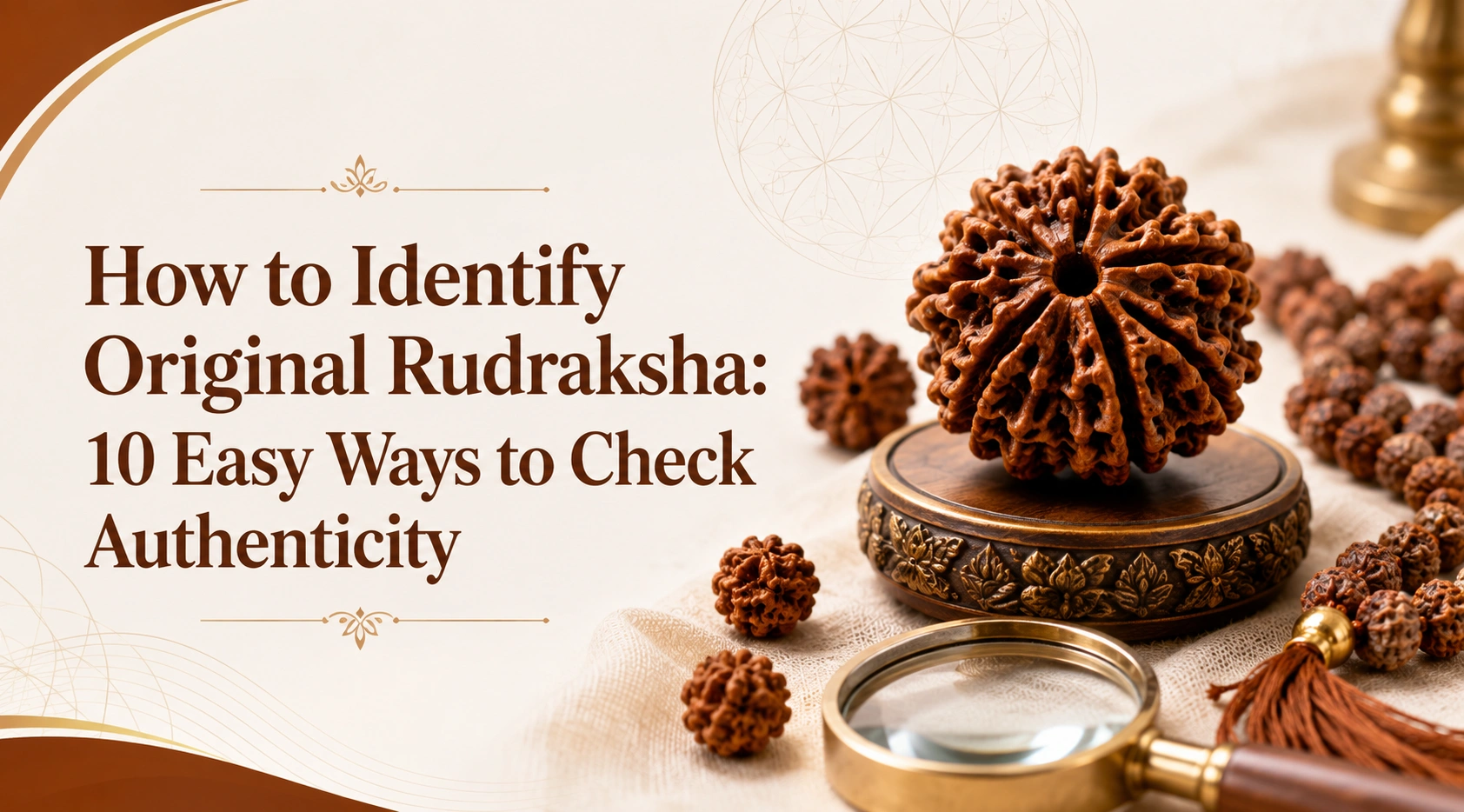
If you have ever bought a Rudraksha online or from a market you know how confusing it can be. Every seller says their Rudraksha beads are from Nepal, natural and blessed by experts. But when you hold the Rudraksha bead in your hand you start to wonder: is this Rudraksha real. Is it just a piece of wood or plastic?
There are a lot of Rudrakshas around today. Some sellers carve lines on low quality Rudraksha beads or they glue plastic pieces together or they use fake things like wooden nuts or resin.
To help you avoid buying a Rudraksha here is a simple guide, on how to check a Rudraksha at home. You can use methods to test your Rudraksha and find out if it is real or not.
Understanding What Makes a Rudraksha Genuine
Before jumping into the testing methods, it helps to know what a natural Rudraksha seed actually looks like under a microscope.
A real Rudraksha is the dried seed of the Elaeocarpus ganitrus tree. Because it grows naturally in nature, no two genuine seeds are ever 100% identical.
- Natural Irregularities: Real beads have uneven grooves (Mukhis), tiny natural depressions, and a rough texture.
- Symmetrical Mukhi Lines: The vertical lines running from the top (head) to the bottom (tail) should flow smoothly without sudden breaks or glue marks.
- Density: Authentic seeds are dense, hard, and carry natural oils within their fibers.
10 Practical Ways to Check Rudraksha Authenticity
Here are 10 simple tests you can perform to verify if a bead is real or fake.
1. The Water Float Test
Place your Rudraksha bead in a glass of clean water.
- Real: A genuine, mature Rudraksha usually sinks to the bottom because of its natural high density.
- Fake: Light plastic knockoffs, unripe beads, or hollow wood imitations usually float on top.
Note: While this test helps catch basic plastic or hollow fakes, some old or dried-out real seeds might also float temporarily. Use this alongside other tests rather than relying on it alone.
2. The Cut or Cross-Section Test (Most Accurate Physical Test)
If you are buying in bulk or want absolute certainty, cutting a sample bead open is foolproof.
- Real: Inside a genuine seed, you will find internal seed chambers (compartments) matching the exact number of Mukhis visible on the outside.
- Fake: Man-made imitations will show a solid interior, carved wooden cores, or hollow centers with glued sections.
3. The Copper Coin Test (Electromagnetic Property)
Rudraksha beads possess subtle natural electromagnetic properties.
- Real: Place the seed between two clean copper coins. With very light pressure, a real bead often shows a slight rotational movement or shift due to its physical structure and natural charge.
- Fake: Artificial materials like plastic, glass, or carved wood stay completely still.
4. The Magnifying Glass Inspection
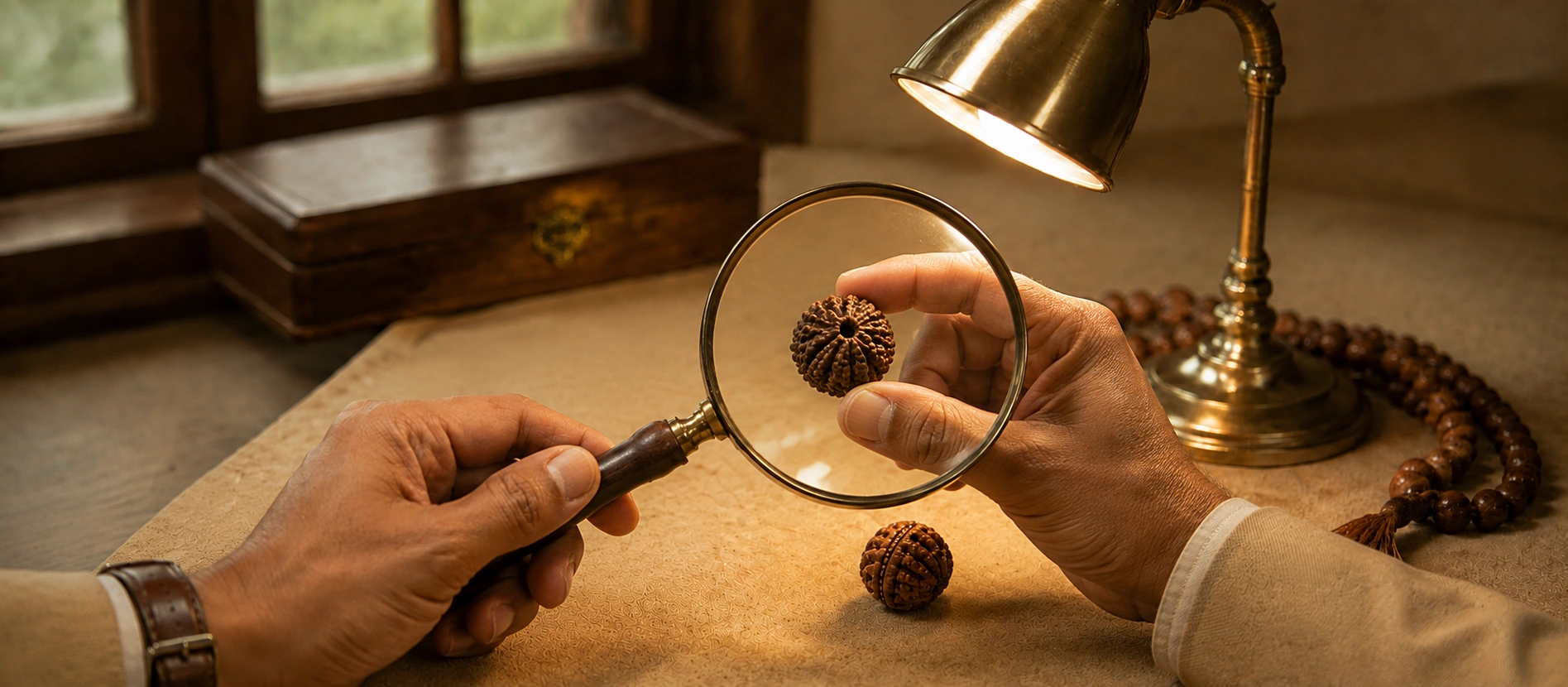
Hold the bead under a basic magnifying glass or strong light source.
- Real: Look closely at the vertical lines (Mukhi grooves). On genuine beads, these grooves are formed naturally within the seed coat and feature tiny, rough, spiky projections across the surface.
- Fake: Carved beads show sharp tool marks, unnatural smoothness, or visible seam lines where two halves were glued together.
5. The Boiling Water Test
Boil the bead in plain water for 30 to 45 minutes.
- Real: Genuine seeds retain their structural integrity, shape, and hardness without discoloring the water excessively.
- Fake: Fake beads made of composite powder, glue, or wax will melt, soften, or disintegrate. Carved wooden fakes will often lose artificial dye and turn the water dark brown or black.
6. The Hot Needle Test
Heat the tip of a metal needle over an open flame until red hot, then gently press it into a small cavity on the bead.
- Real: The needle will encounter hard resistance. You might smell a mild, natural woody scent or faint smoke, but the bead will not melt.
- Fake: If the needle easily pierces the bead or smells like burning plastic, chemical varnish, or synthetic glue, it is fake.
7. The Natural Contour & Texture Check
Examine the physical appearance of the bead under good lighting.
- Real: Nature is rarely perfectly symmetrical. Real beads feature natural contour variations, slight color differences, and rough outer skin patterns.
- Fake: If a bead looks suspiciously perfect, perfectly round, or identical to every other bead in a string, it was likely produced in a factory mold.
8. The Mukhi Line Alignment Test
Trace each vertical line (Mukhi) from the top aperture to the bottom aperture.
- Real: The lines travel naturally from top to bottom without artificial interruptions, deep gouges, or sudden ends.
- Fake: Scammers often alter low-cost 1-Mukhi or 4-Mukhi beads by carving extra lines onto the surface to sell them as rare multi-faced beads. These carved lines usually look scratchy and shallow under inspection.
9. The Temperature & Surface Touch Test
Pay attention to how the bead feels when you hold it in your hand.
- Real: Natural seeds adapt to ambient room temperature and feel slightly cool initially when picked up. They slowly warm up as you hold them.
- Fake: Plastic and synthetic beads match body heat almost instantly and lack the heavy, solid, natural tactile feel of real seed fibers.
10. X-Ray Examination (The Gold Standard)
For high-value, rare beads (such as 1-Mukhi, 14-Mukhi, or Gauri Shankar), an X-ray scan is the most definitive non-destructive test available.
- Real: An X-ray clearly shows the internal central cavity and individual seed compartments matching the external faces (Mukhis).
- Fake: Reveals internal wooden dowels, lead weights, metal wires, or glued joints hidden beneath the outer surface.
Real vs. Fake Rudraksha: Key Comparison
Inspection Factor | Genuine Rudraksha | Fake / Altered Rudraksha |
Internal Structure | Compartments match external Mukhis | Solid interior, hollow center, or glued parts |
Water Behavior | Usually sinks (mature seeds) | Floats (plastic/hollow wood) or bleeds dye |
Heat Resistance | Withstands hot needle without melting | Melts, burns like plastic, or emits glue odors |
Surface Lines | Deep, organic, continuous grooves | Shallow, carved, or manually painted lines |
Consistency | Unique shapes, natural surface spikes | Machine-perfect symmetry, uniform texture |
Common Market Scams to Avoid
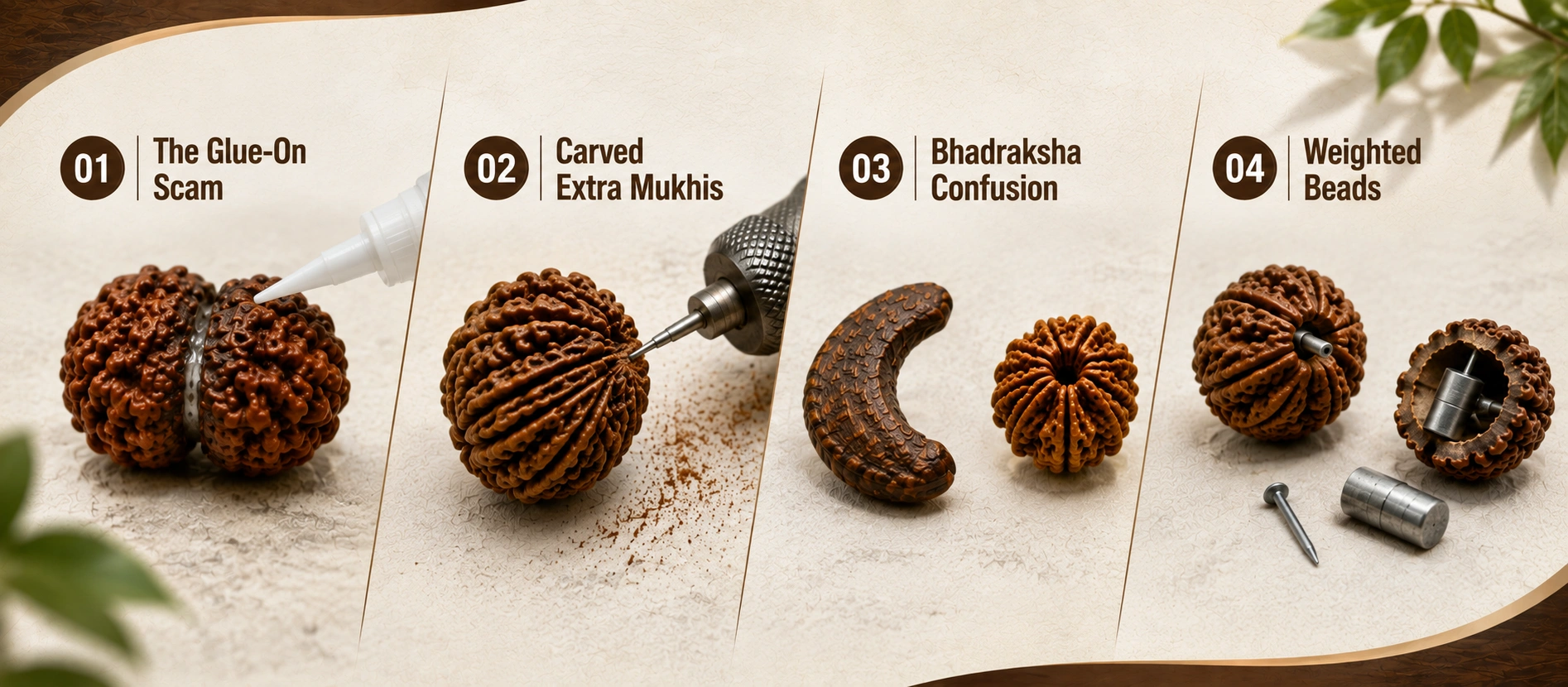
Knowing how beads are tampered with helps you spot fake listings immediately:
- The Glue-On Scam: Joining two standard beads together to sell them as a rare Gauri Shankar Rudraksha.
- Carved Extra Mukhis: Taking a common 4 or 5 Mukhi bead and cutting manual lines into it to sell it as a rare 12 or 14 Mukhi bead.
- Bhadraksha Confusion: Selling Bhadraksha (a cousin seed that grows flat like a crescent moon) as genuine 1-Mukhi Nepalese Rudraksha. Bhadraksha seeds lack the spiritual properties and structural features of true Elaeocarpus ganitrus.
- Weighted Beads: Inserting lead wire or small nails into carved holes so light wooden fakes pass the water sinking test.
If you are looking to wear specific beads for personal growth or astrological reasons—such as exploring 6 Mukhi Rudraksha Benefits for focus and confidence—always demand lab test certificates before completing your purchase.
Why Lab Certification Matters
While home tests are helpful for basic screening, high-grade imitations can sometimes pass basic physical checks.
The safest way to ensure your spiritual items are 100% natural, untreated, and uncarved is to buy directly from reputable sources that provide independent ISO-certified laboratory test reports with clear X-ray images.
Ready to find authentic, lab-certified beads for your daily practice? When you choose to Buy Rudraksha from ratnakendra, every single bead is carefully hand-picked, rigorously tested, and delivered with genuine laboratory certification so you get 100% natural spiritual energy with absolute peace of mind.